Governance insight

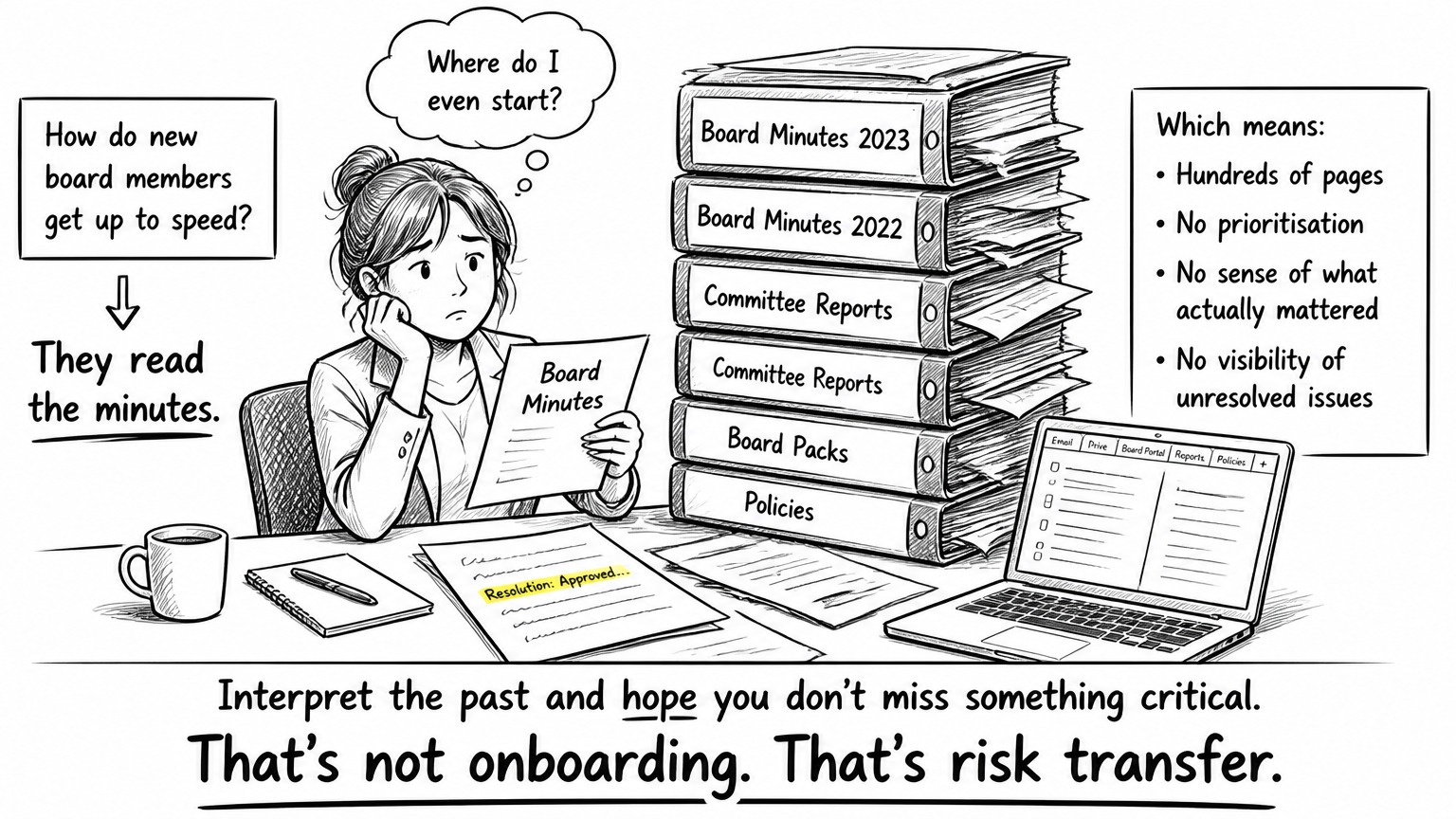
I asked a group of school leaders how new board members get up to speed.
There was a pause. Then, with a slight laugh:
"They read the minutes."

They knew, as they said it, what that actually means.

Which means:

  • Hundreds of pages — with no prioritisation
  • No sense of what actually mattered, or what was ever resolved
  • No visibility of the tensions that still sit unaddressed
  • No picture of what the board currently holds

The gap between what boards call handover and what new members actually need.

That's not onboarding.
That's risk transfer.

Minutes record what happened.
Not what still holds.

Reading three years of minutes is not a handover process. It is an archaeology project - sifting through a sequential record of meetings to reconstruct a picture that should already exist.

What a new board member actually needs:

  • Which decisions are currently active and operative?
  • What tensions remain unresolved at board level?
  • What is the current policy position - and what is under review?
  • What has been discussed but never formally concluded?

None of those answers are in any individual set of minutes. They are scattered across years of records - with no signal about what still applies and what has since changed.

Most boards ask
"Have you read everything relevant?"
The question that actually matters
"Do you understand what currently holds?"

A new board member is not starting from scratch. They are inheriting a live governance position - active commitments, open questions, and current policies that the board holds at this moment.

If they cannot access that picture directly, they must reconstruct it from memory - their own reading, or the recollections of members who were there. That is not continuity. It is dependency on memory. And memory leaves when people do.

The archive no one accounts for

Much of a board's institutional knowledge never reaches the formal record at all. It lives in the email chains between the chair, the head, and the clerk - the context behind a decision, the reason a proposal was quietly withdrawn, the concern raised informally before it reached any agenda.

When someone leaves, those chains go with them. They are not discoverable. They are not handed over. They are not minutes. But they are where much of the real governance happened - the reasoning, the negotiation, the institutional memory that explains why things are the way they are.

A new board member does not just inherit a gap in the formal record. They inherit a gap in the informal one too - and they will never know what they are missing.

From reading the past to understanding the present

The information a new board member needs is not hidden. It exists - in decisions made, policies adopted, tensions raised. The problem is that it is buried in a sequential archive rather than held in a structure that reflects the board's current position.

Continuity is not produced by thorough minutes. It is produced by a system that maintains the current state of governance as a live picture any authorised member can access at any time.

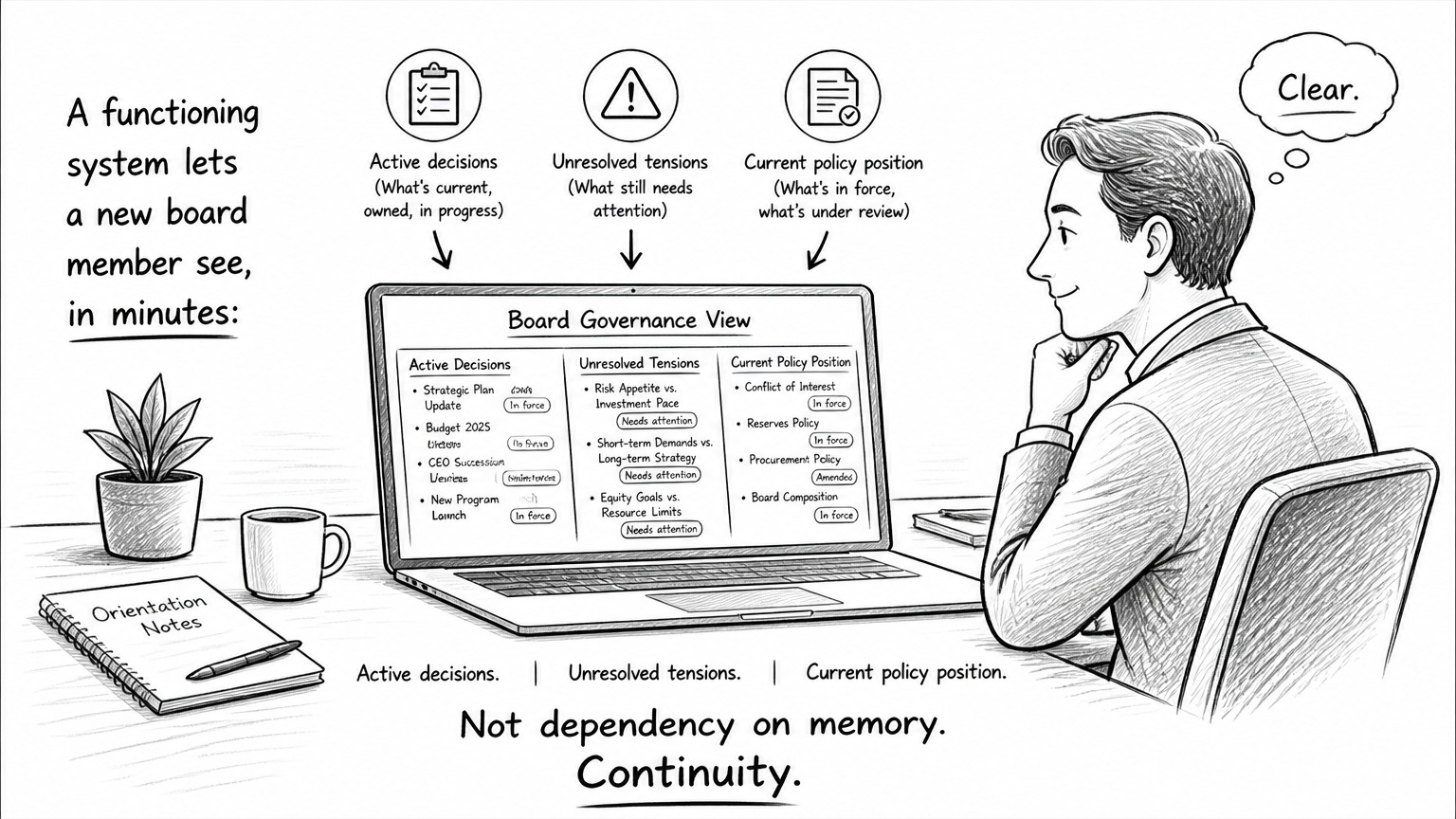
A functioning governance system shows active decisions, unresolved tensions, and current policy position at a glance - continuity, not dependency on memory

A functioning system gives a new board member that picture in minutes - not months of reading.

Three things a new member needs to see immediately.

Not summaries. Not induction documents assembled by the clerk. Live governance views that reflect the board's current position - updated as decisions are made, not compiled retrospectively when someone new arrives.

Active Decisions

What's current, owned, and in progress

The decisions the board currently holds - not historical records but live commitments shaping what the school does right now.

  • What was resolved and when
  • Current status: adopted, amended, under review
  • Who owns the outcome
  • What it produced - a policy, an action, a commitment

Unresolved Tensions

What still needs attention

The questions the board has raised but not yet closed - deferred, noted, discussed without conclusion, and still live.

  • Issues raised across multiple meetings
  • Decisions deferred without a return date
  • Strategic tensions that remain open
  • Areas where the board's position is unclear

Current Policy Position

What's in force, what's under review

Not the folder where policies are stored - the live record of what is adopted, what is under review, and what the board has approved.

  • Which policies are currently in force
  • Which are overdue for review
  • Which are under active revision
  • What each policy links to in the governance record

Four questions. Before the first meeting.

With this structure in place, a new board member can answer these questions independently - before attending their first meeting, without asking a colleague to brief them, without reading years of archived minutes.

Question 1

What are the three most significant decisions the board currently holds?

Question 2

What issues are unresolved at board level - and how long have they been open?

Question 3

Which policies are under review, which are overdue, and who owns each?

Question 4

What did the board decide last year that directly shapes what the school is doing right now?

The standard to aim for
A new board member should be able to understand the board's current governance position before attending their first meeting - not after six months of reading. If that is not possible, the information exists somewhere. It is just not held in a form that serves continuity.

Where memory dependency fails

Boards with strong, long-serving members often have genuine institutional knowledge - and it works, until it doesn't. When experienced members leave, that knowledge leaves with them. What remains:

  • New members who cannot access the board's history independently
  • Chair or clerk briefings that depend on individual recollection
  • Critical context locked in the memory of people no longer in the room
  • Email chains that were never part of any formal record
  • Governance continuity that is one resignation away from breaking

The question is not whether your current board can provide continuity. It is whether your system can.

Loom is built for this

Loom maintains the three pillars of governance continuity as live records - not archives to be searched, but a current governance view that any authorised member can access from day one.

  • Active decisions tracked with status, ownership, and linked outputs
  • Unresolved issues visible across meetings, not buried within them
  • Policy position maintained as a live record, not a folder of dated files
  • A new member can access the full current governance picture on arrival
  • Institutional knowledge held in the system - not in the people who happen to be there

Not dependency on memory. Continuity.

Board Deck Standard 6.2: Succession Planning and Continuity ↗

Think about your most experienced board member

If they left at the end of this year, which of these would be true?

A new member could access the board's current governance position - active decisions, open tensions, policy status - without being briefed by anyone.

Every significant decision from the last three years has a current status, an owner, and a link to what it produced - findable in under 60 seconds.

The institutional knowledge that person carries - including what never reached a formal record - is held in your system, not in their inbox.

If any of those isn't true, your governance continuity is person-dependent, not system-dependent. That is a governance risk - one that compounds quietly until someone significant leaves.
SYNNOVATELeadership FrameworksDECKSLeadership PracticeLOOMOrganisational Infrastructure

Synnovate connects leadership frameworks, leadership practice, and organisational infrastructure.

LOOM provides the infrastructure that captures signals from real work and reveals patterns across the organisation.

Explore Loom → loom.education