1
Decision
A precise statement of what was agreed - written so someone outside the meeting understands it without context. No narrative. No preamble. Just what was resolved.
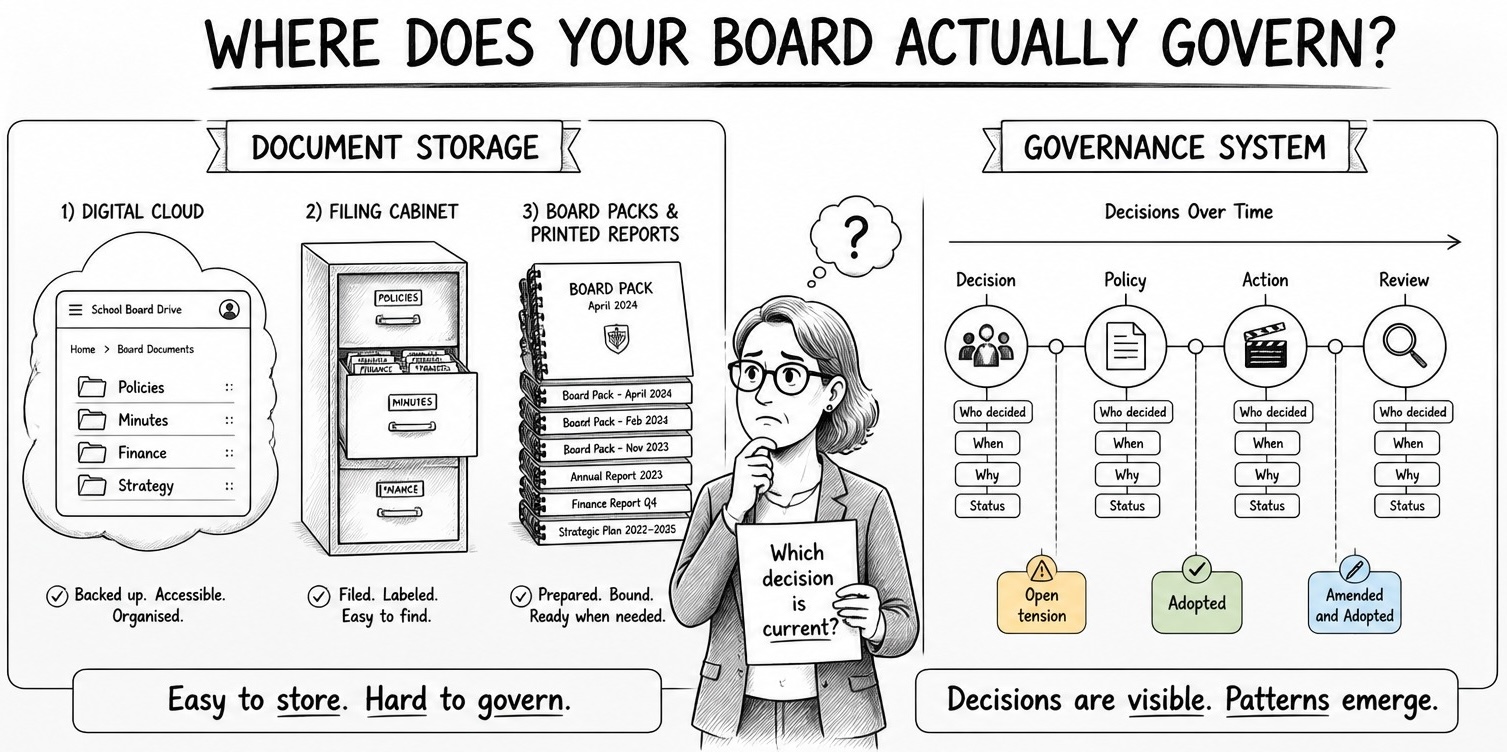
Not where they store documents. Where they govern.
Most boards have solved the wrong problem. Documents are stored, categorised, backed up. But governance is not about where decisions live.
The problem
It is evidence that meetings happened.
Governance is the ability to establish, at any point in time, the current state of the board's decisions - what was agreed, whether it still holds, what it produced, and who owns it now.
If answering any of these requires searching through minutes, the decisions are recorded - but not governed.
The question to ask
These are different questions. The first points to a document. The second points to a record that lives, changes, and connects to other records over time.
A decision is not an event. It is a position the board holds until something explicitly changes it.
The shift
Treating decisions as standalone records - not as text buried in minutes - is what makes governance traceable. It does not require new technology. It requires a different structure applied consistently.
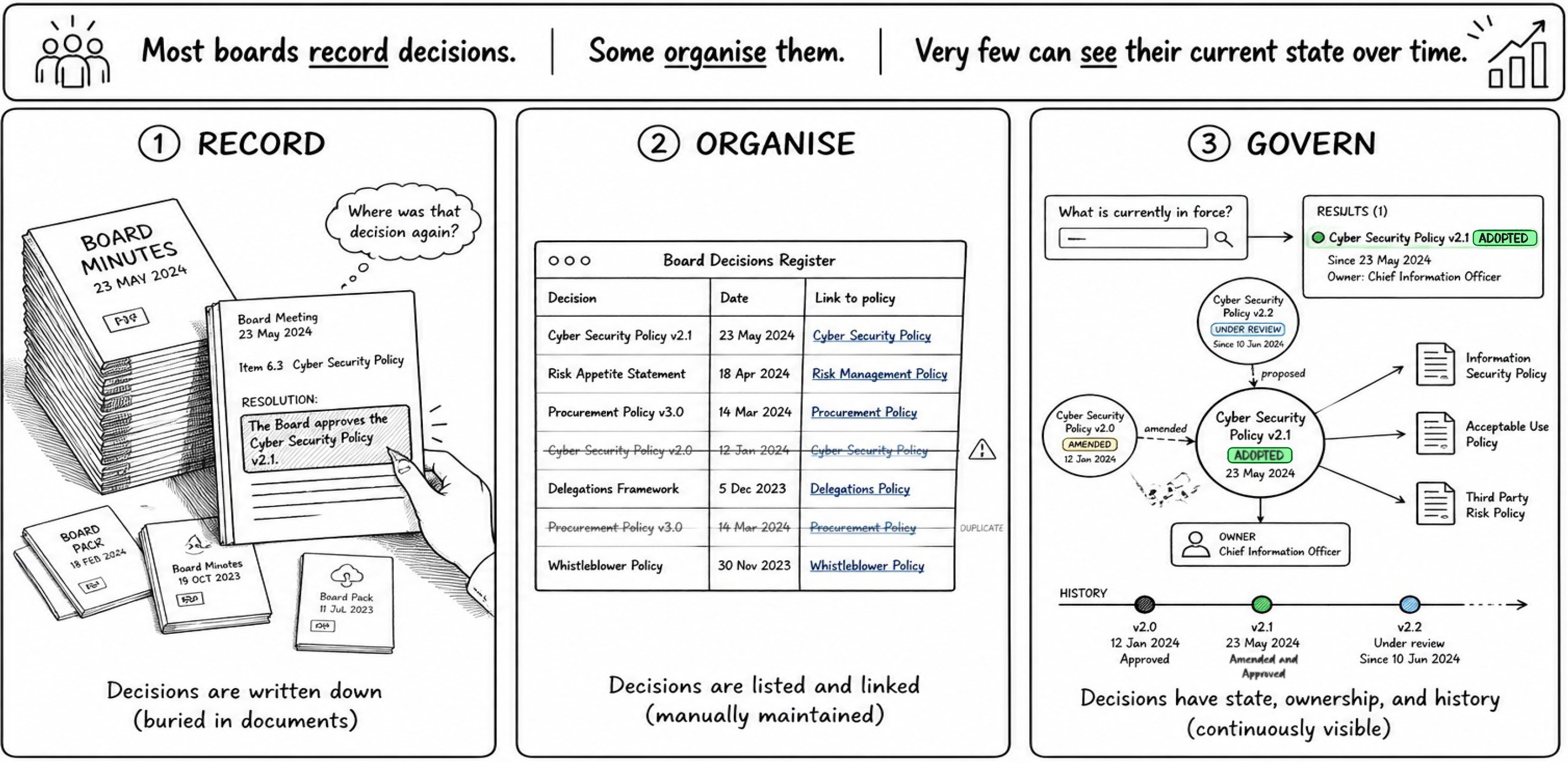
Most boards record decisions. Some organise them. Very few can see their current state over time.
The structure
Each decision becomes a standalone record with six fields. This is not a new system - it is a consistent structure applied to decisions you are already making. The value compounds over time as the register grows.
A precise statement of what was agreed - written so someone outside the meeting understands it without context. No narrative. No preamble. Just what was resolved.
Once adopted, a decision remains adopted until it is explicitly changed. Status tells you its current position - not just its history.
If this field is missing or unclear, the decision is not traceable.
Capturing the review date at the point of adoption is what makes the register proactive, not retrospective.
Decisions without owners are intentions, not commitments.
Links are what turn a list of decisions into a governance chain.
Why this was decided - 1 to 2 lines. Not the full discussion, just enough context to avoid re-debating the same question at the next meeting.
The most overlooked field. The most useful one when a decision is challenged.
What this enables
With this structure in place - even in a spreadsheet - these questions become answerable at any point in time. If they are not, the structure is incomplete.
Which decisions are currently adopted and operative?
Which decisions have been amended or superseded in the last 12 months?
Which decisions are pending board consideration - and since when?
What is due for review in the next three months, and who owns each item?
The honest limitation
This structure works well until the volume of decisions grows. At that point, boards typically encounter:
At that point, the challenge is not the structure - it is the system that holds it.
The structure described on this page is what Loom implements natively - decisions as live records, connected to the policies, actions, and reviews they produce.
Not more documentation. A different way of governing.
Board Deck Standard 5.1: Monitoring and Evaluation of Strategic Goals ↗The test
Pick any significant decision your board made in the last two years. Try to answer these three questions - right now, without searching.
Is it adopted, amended, or superseded? And can you point to the record that changed it, if it changed?
What did it produce? A policy, an action, a commitment to review - and what is the current state of that output?
Who owns it now, and when is it next due for reconsideration?