On track
Progressing as intended
Implementation is active, up to date, and unfolding in line with the strategic objective. The board has no action to take.
Generated automatically - from activity and progress in the implementation layer
The strategic plan is approved.
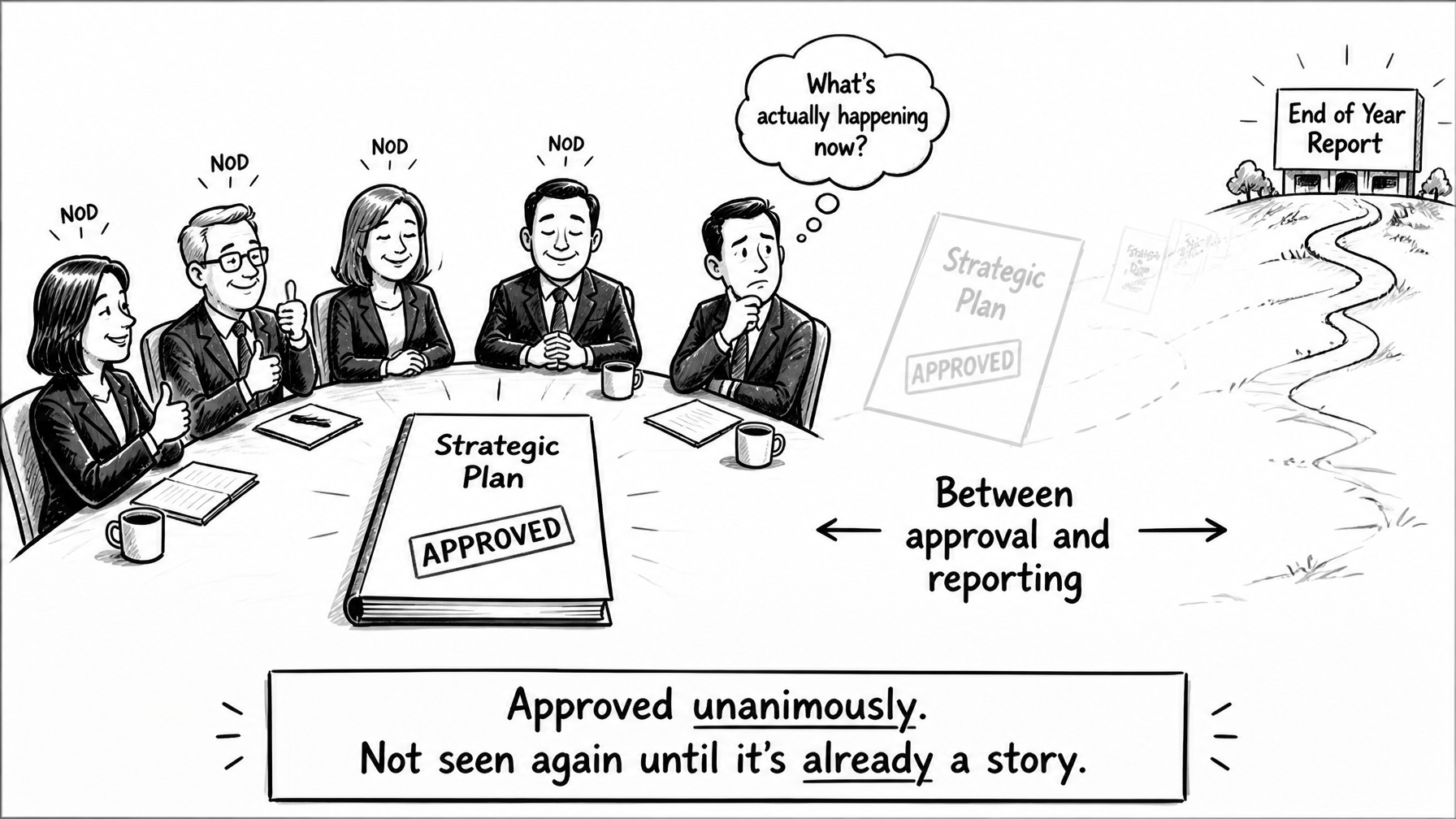
Unanimously, usually. After real effort. Priorities agreed, language refined, the board aligned on what matters most for the year ahead.
Then something subtle happens.
The plan moves into implementation. Into leadership workstreams, meetings, decisions. And between approval and the year-end report, the board typically has no clear view of:
The gap between what boards approve and what they can see.
The problem
When the board next encounters the strategic plan at year-end, the framing is already set. "Strong progress." "Most priorities addressed." "More to do, but overall a successful year." Approved unanimously - again.
But there was no moment during the year when the board could see what was actually happening. No point at which they could adjust, redirect, or signal concern before the narrative was already written.
The issue is not effort or intent. It is that the board had no shared way to see the plan as it was unfolding - only to approve it at one end and receive a report at the other.
The question to ask
These are different questions. The first is answered at year-end with a narrative. The second requires continuous visibility - something most boards do not have.
Two governance rhythms
Most boards operate episodically - approval and reporting as the two contact points, with trust filling the space between. Continuous governance does not mean more meetings or more reporting. It means the board can see what is happening, in real time, without waiting for the next report.
Episodic governance
Continuous governance
The shift
Continuous governance does not mean the board steps into leadership's work. The implementation detail - the workstreams, the tasks, the day-to-day decisions - belongs to leadership. The board governs the outcomes: whether each strategic priority is on track, whether something has stalled, and where the board's attention is actually needed.
That distinction - between governing outcomes and managing activity - is what makes continuous governance possible without it becoming operational overreach.
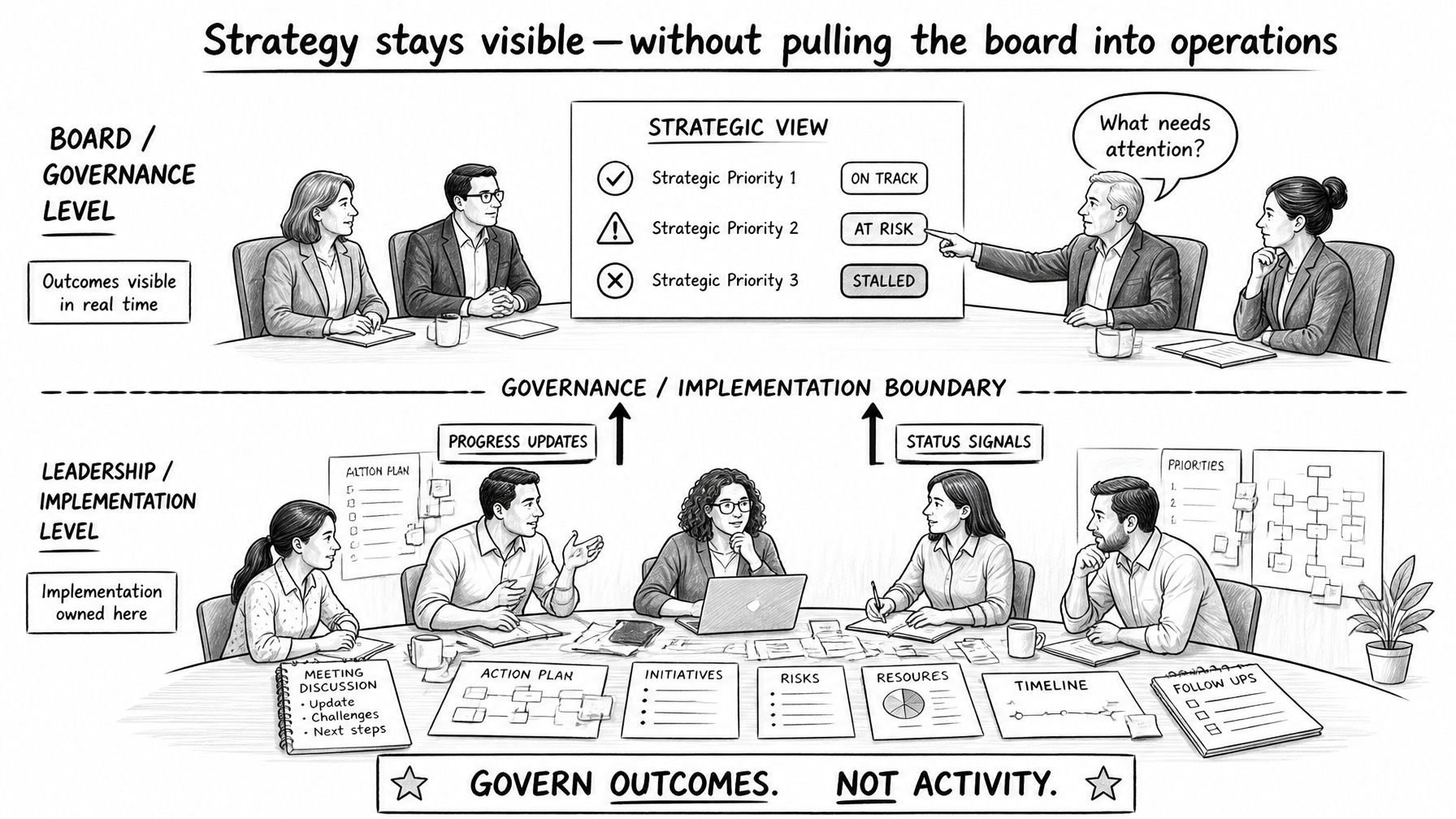
The board sees strategic outcomes. Leadership owns the implementation. Progress and status signals travel up - not the other way around.
What the board sees
Rather than waiting for a narrative, the board sees a small number of clear status signals for each strategic objective - surfaced continuously from the implementation layer below. Three of those signals are generated automatically; one is set deliberately by the board itself.
Implementation is active, up to date, and unfolding in line with the strategic objective. The board has no action to take.
Generated automatically - from activity and progress in the implementation layer
Progress is low relative to the timeline, or implementation activity has been absent for an extended period. The strategic objective may not be achieved without adjustment.
Generated automatically - when progress is low with an imminent deadline, or when no update has been recorded in 45 days
Implementation activity has stopped. No update, no progress, no signal of active work. The strategic objective is not progressing.
Generated automatically - when no activity has been recorded in the implementation layer for 30 days or more
This signal is different. It is not generated by the system - it is set deliberately by the board or chair as a formal escalation. It records that the board has exercised oversight and determined that something needs closer scrutiny.
Set deliberately - by the board or chair, as a governance act, not a system alert
What this enables
With this structure in place, these questions are answerable by the board at any time - not only at the point when a report has been prepared. If they cannot be answered without a report, the board is operating episodically.
Which of our strategic priorities are currently on track, and which are not?
Is anything stalled - and how long has it been without visible progress?
Which objectives have we formally placed under observation, and why?
Where is our attention genuinely needed - before it becomes a year-end story?
The honest limitation
Most boards do not feel they are operating without visibility. Trust in leadership is genuine, and year-end reports usually confirm it. The failure is subtle:
The question is not whether leadership is trustworthy. It is whether the board's oversight depends entirely on that trust - or whether the structure holds it independently.
Loom separates the two tiers of strategy formally. Leadership owns and drives operational implementation. The board governs the strategic outcomes - and the status signals surface automatically from what is actually happening below.
Not more reporting. A shared way to see the plan as it unfolds.
Board Deck Standard 2.2: Strategic Planning and Innovation ↗The test
Without looking at a report, can your board answer these right now?
You can name which strategic priorities are currently on track and which are not - without waiting for the next headteacher's report.
You know if any objective has stalled - and roughly how long it has been without visible progress.
The board can distinguish between what is genuinely progressing and what has been quietly deprioritised since approval.