Governance insight

The safeguarding policy has been updated. The board approved version 3.2 at the May meeting.
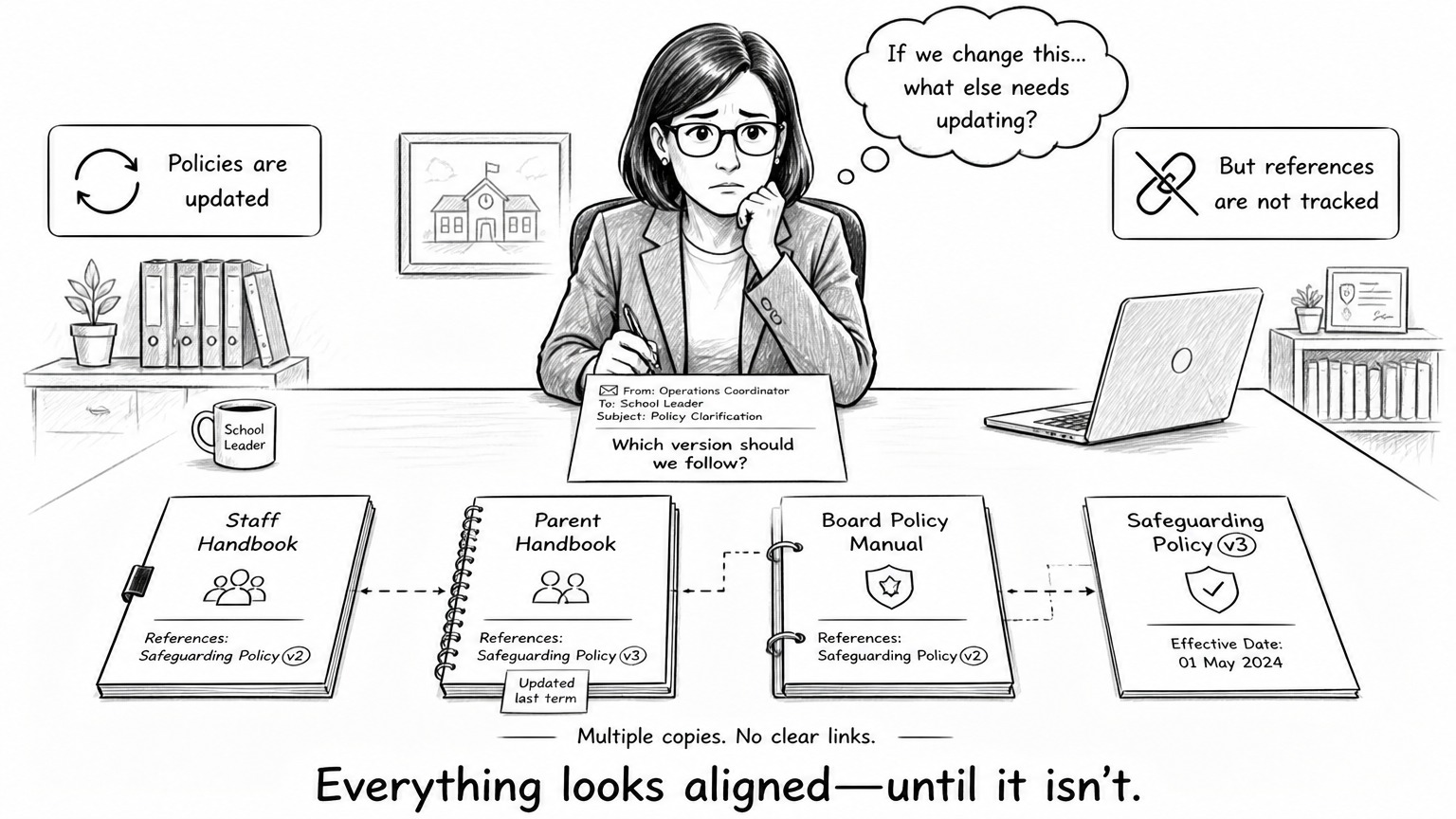
The Staff Handbook still references version 2. The Parent Handbook references version 3, updated last term. The board policy manual references version 2 — the one from the year before. An email arrives this morning: which version should we follow?

Nobody has a list of everywhere the policy is cited. Nobody knows how many copies exist.

This is a predictable consequence of how most schools manage policies. A policy is approved, filed, and then distributed — copied into handbooks, linked in induction packs, uploaded to the school website, embedded in guidance documents. When it is updated, the folder changes. Everything else changes when someone notices. Or when someone asks.

Policy distribution is the discipline of controlling how a policy reaches the people who need it — in a form appropriate for each audience, without duplicating the document — so that when the board approves a new version, all downstream references update in step, automatically. Without that discipline, the question is not whether a mismatch exists. It is how many mismatches, and when the next one will surface.

  • Whether the copy staff are working from matches what the board approved
  • Which handbooks, portals, and embedded references still carry an earlier version
  • Whether different audiences — staff, parents, governors — have access to the policy in a form appropriate to them
  • When the last update was published downstream — and whether the people who needed it were notified
  • Whether anyone can identify all the places a specific policy is currently referenced

The gap between updating a policy and distributing the right version.

Updated. Filed. Distributed.
But not the four documents that reference it.

When a policy changes,
everything that references it needs to change too.

Most schools do not have a complete list of where each policy is cited. The safeguarding policy appears in the staff handbook, the induction pack, the governor training materials, the school website, and possibly a Google Doc created three years ago that nobody has updated since. Each is a copy made at a specific point in time.

When the board approves version 3.2, the approved document is filed. Updating everything downstream — each handbook, each portal, each embedded reference — depends on someone knowing where to look and remembering to do it. Neither is reliably true across multiple review cycles and several changes of leadership.

The result is a policy environment where the board's approval record says one thing and the documents staff and parents are actually reading say something slightly different. Not wrong enough to cause immediate problems. Wrong enough to matter the moment anyone asks.

What copy-and-paste publishing gives you
Multiple documents all containing versions of the same policy — each of which may be slightly out of date, slightly adapted for its audience, and completely disconnected from the board's approval record. No mechanism for knowing which one is current. No way to update them all at once.
What audience-controlled distribution requires
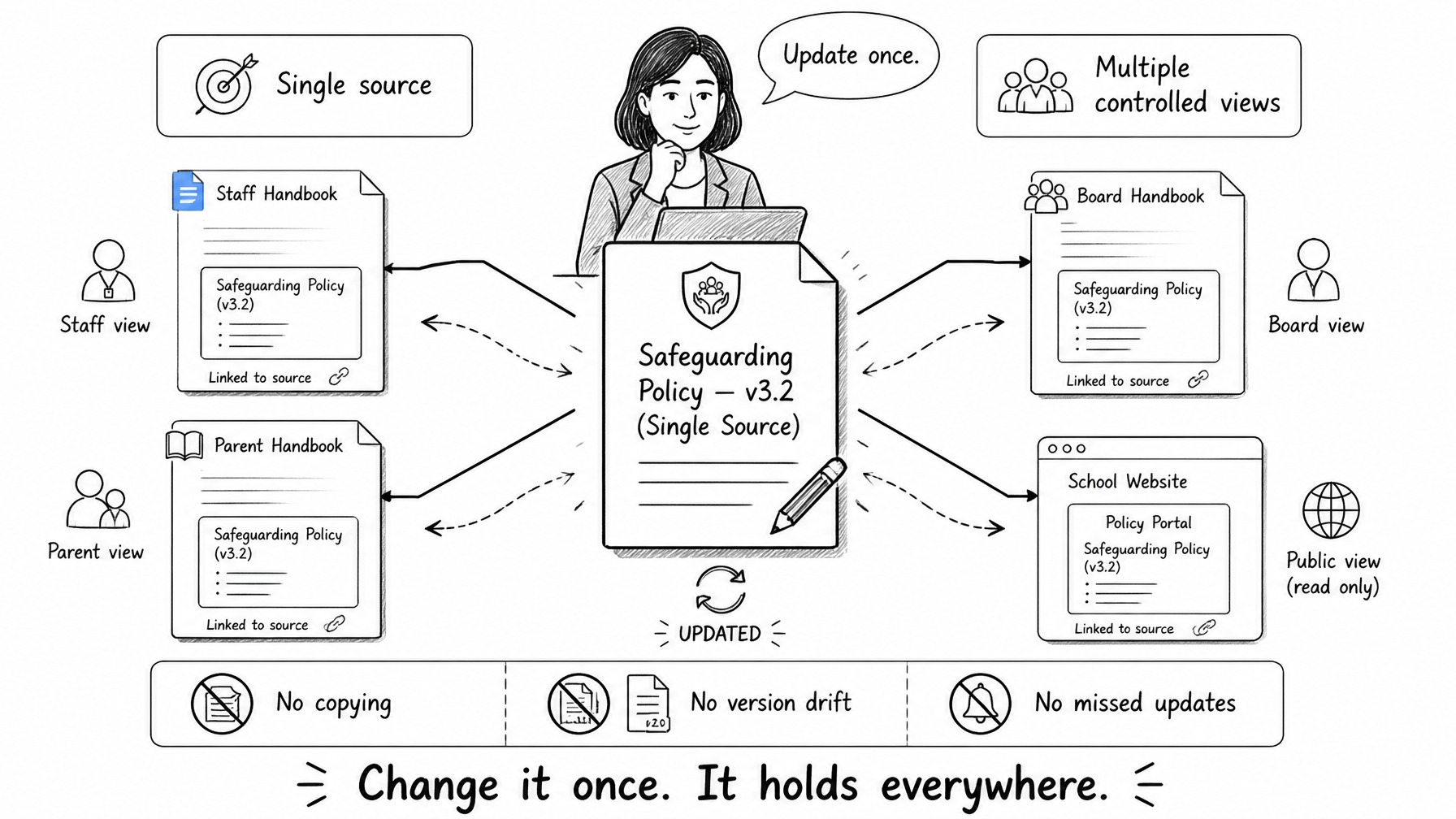
A single source of truth for each policy, with the ability to present the right view to each audience — without copying. When the board approves a new version, all downstream references update. No manual distribution step. No version gap.

Different audiences legitimately need different access. Staff need the full operational detail. Parents need a readable summary or specific sections. Governors need the complete record including version history and approval chain. Managing three separate copies is not the same as managing three views of the same document. Only one of those keeps them in step.

Manual distribution vs controlled single-source publication

The difference is not about adding steps — it is about what happens when the board approves a new version. With manual distribution, each downstream reference requires a separate update. With controlled publication, the approval is the update: the source changes, and everything linked to it changes with it.

Manual distribution

1
Board approves new version
Noted in minutes
2
Updated in shared drive
Previous version archived (or left in place)
3
Staff handbook updated
If someone remembers
4
School website updated
Check with the IT team
5
Other references: unknown
No list of where the policy is cited

Controlled single-source publication

1
Board approves new version
Linked to meeting record — version, date, resolution
2
Policy portal publishes automatically
Always the board-approved version — no manual step
3
Audience views configured once
Staff, parent, public — different access, same source
4
Embedded references update in step
Transclusion — not a copy, a live reference
5
One change. Held everywhere.
No drift. No version gaps. No manual chase.

One policy. Four audiences.
All reading the same source.

A policy portal is not a duplicate of the governance record — it is the live face of it. When the board approves a new version, the portal updates. When a section of the safeguarding policy is embedded in the staff handbook or a Google Doc via transclusion, that reference updates too — automatically, without anyone copying from a shared drive or notifying a team to check the link.

The audience access level is set once, not every time. Staff see the full operational policy. Parents see the sections appropriate to them. Governors see the complete record. Nobody downloads a copy that will be out of date in six months.

A single source Safeguarding Policy v3.2 connected by arrows to four destinations: Staff Handbook with a Staff view labelled Linked to source, Parent Handbook with a Parent view labelled Linked to source, Board Handbook with a Board view labelled Linked to source, and School Website Policy Portal with a Public view read-only labelled Linked to source. A school leader says: Update once. Labels: Single source — Multiple controlled views. Bottom bar: No copying — No version drift — No missed updates. Caption: Change it once. It holds everywhere.

Change it once. It holds everywhere.

Four disciplines. Each one closing a gap.

These are not features in the conventional sense — they are the mechanisms that prevent version drift. A school that cannot satisfy all four is not distributing policies. It is copying them and hoping the copies stay in step.

Single source

One place where the board-approved version of each policy lives. Not a shared drive folder with multiple copies named slightly differently. A single record that carries the approval chain, version history, and review schedule — and from which all downstream references draw.

What it answers: which document is the approved version

Audience-controlled views

Staff, parents, governors, and the public all need different access to school policies. Audience-controlled views let each group see the relevant content from the same source — without creating separate copies. The access level is set once; the source is always the board-approved version.

What it answers: who sees what, from which source

Policy portal

A single destination — for staff, for governors, for parents — where the current approved version of every policy is always available. Not a folder. Not the school website with an upload from eighteen months ago. The actual approved document, updated automatically when the board approves a new version.

What it answers: where do people go to find the current policy

Transclusion

Embedding a policy — or a specific section of it — in another document as a live reference, not a copy. When the board approves a new version, any document using transclusion updates automatically. Individual sections can be embedded by subheading, so only the relevant part appears in each context. The embed carries no access control of its own — it should be placed in a document appropriate to its audience.

What it answers: how downstream references stay in step

Four questions. Answerable without a phone call.

With controlled distribution, these questions have immediate answers — not because someone has been diligent about manual updates, but because the architecture prevents the drift from occurring in the first place.

Question 1

If the board approved a new version of the anti-bullying policy today, which documents would still carry the old version tomorrow?

Question 2

Do staff, parents, and the board all have access to the safeguarding policy in a form appropriate to them — from the same source?

Question 3

Can you identify every place a specific policy is currently referenced — and confirm each one reflects the version the board approved?

Question 4

When a section of the safeguarding policy was embedded in the staff handbook, was it a copy made at a point in time — or a live reference that updates when the board approves a new version?

The standard to aim for
A policy approved by the board in May should be the version staff and parents are reading in June — not the version from last year that nobody noticed was out of date. Achieving that is not a matter of diligence. It is a matter of architecture: single source, live references, audience-controlled access, no copies.

Where manual distribution fails quietly

The failure rarely announces itself. Policies are broadly current. Audits pass. The version drift accumulates in the background — in handbooks updated last year, in Google Docs nobody has touched since the review cycle before last, in website pages nobody has permission to change without contacting the IT team.

  • No complete list of where each policy is cited — updates reach the folder but not the references
  • Staff handbooks, induction packs, and guidance documents carry different versions of the same policy
  • The school website policy section is updated when someone remembers — not when the board approves
  • Google Docs containing policy content are copies, not references — they do not update when the source changes
  • When leadership changes, institutional knowledge of which version is current goes with them
  • An inspector asks for the current safeguarding policy. Multiple documents are produced, each slightly different

The question is not whether policies are broadly up to date. It is whether the board can demonstrate — at any point, to any reviewer — that the version available to staff and parents is the one the board approved. Manual distribution cannot guarantee that. Controlled single-source publication can.

Loom is built for this

In Loom, the approved version of a policy is not filed — it is published. The approval at the board meeting triggers the update. The policy portal reflects the current version immediately. Embedded references update in step. No manual distribution step is required, and no copy is made.

  • Single source: every policy lives in one record — approval chain, version history, and review cycle in one place
  • Audience-controlled views: staff, parents, and the public see the policy in the form appropriate to them — different access levels, same source
  • Policy portal: always the board-approved version, always current, accessible without contacting anyone
  • Transclusion: policies and individual sections can be embedded in Google Docs as live references — when the board approves a new version, any linked document updates automatically
  • Section-level embedding: individual subheadings can be embedded separately, so only the relevant section appears in each context

Update once. The right version reaches the right audience — automatically.

Board Deck Standard 4.1: Transparent Communication and Advocacy ↗

Think about your safeguarding policy

Without contacting the IT team, searching the shared drive, or calling anyone — can the board answer these right now?

If the safeguarding policy was updated at the last meeting, you can confirm that the version on the school website, in the staff handbook, and in the parent-facing area all reflect that update — without checking each one manually.

Staff, parents, and governors all have access to the current approved policy in a form appropriate to them — from one source, not three separate documents maintained independently.

If a section of the safeguarding policy was embedded in the staff induction pack, that reference reflects the board-approved version — not a copy made when the handbook was last updated.

If any of those requires a search, a phone call, or a manual check, the policy is distributed as copies — not governed as a single source. That gap accumulates with every review cycle. Each time the board approves a new version, the number of out-of-date references grows by however many were not manually updated. It surfaces clearly when someone asks which version they should be working from — and the honest answer is: we are not certain.
SYNNOVATELeadership FrameworksDECKSLeadership PracticeLOOMOrganisational Infrastructure

Synnovate connects leadership frameworks, leadership practice, and organisational infrastructure.

LOOM provides the infrastructure that captures signals from real work and reveals patterns across the organisation.

Explore Loom → loom.education